The columnar shuffle over Arrow Flight
How a shuffle stage's map outputs get from one executor to another without leaving Arrow memory: the file the map side writes, the Flight service that streams it, the reader that turns it back into column batches, and the decisions behind each. Written after the 1000-partition work (#411, #416); the issue numbers point at the measurements that motivated a choice.
- Code:
shuffle/--VectorShuffleExchangeExec(inspark/),VectorShuffleManager,PartitionedIpcWriter,PartitionedIpcFile,VectorShuffleBackend,flight/FlightShuffle. - Tests:
PartitionedIpcSuite,FlightBlockStreamSuite,FlightShuffleClusterSuite,VectorShuffleSuite. - Benchmark:
FlightShuffleBenchmark(benchmarks/scripts/run-flight-bench.sh).
1. Why a shuffle of our own
Spark's shuffle is row-based: a columnar operator feeding ShuffleExchangeExec converts every batch
to UnsafeRows, the sort-based writer serialises them per partition, and the reducer deserialises
rows the next columnar operator converts back into columns. For a plan whose operators are all ours
that is two conversions and a serialiser round trip per stage, and it was the largest single cost of
the TPC-DS campaign on plain Spark's shuffle (#288). Comet has the same problem and the same answer:
a ShuffleManager that handles only its own dependency type and leaves every other shuffle to
Spark's sort shuffle untouched.
Ours moves Arrow record batches. The map side partitions a ColumnarBatch with the partitioning
kernels and appends each partition's rows to that partition's builders; the reduce side decodes IPC
messages straight into Arrow vectors the operators read in place. Nothing is a row in between.
2. The pieces
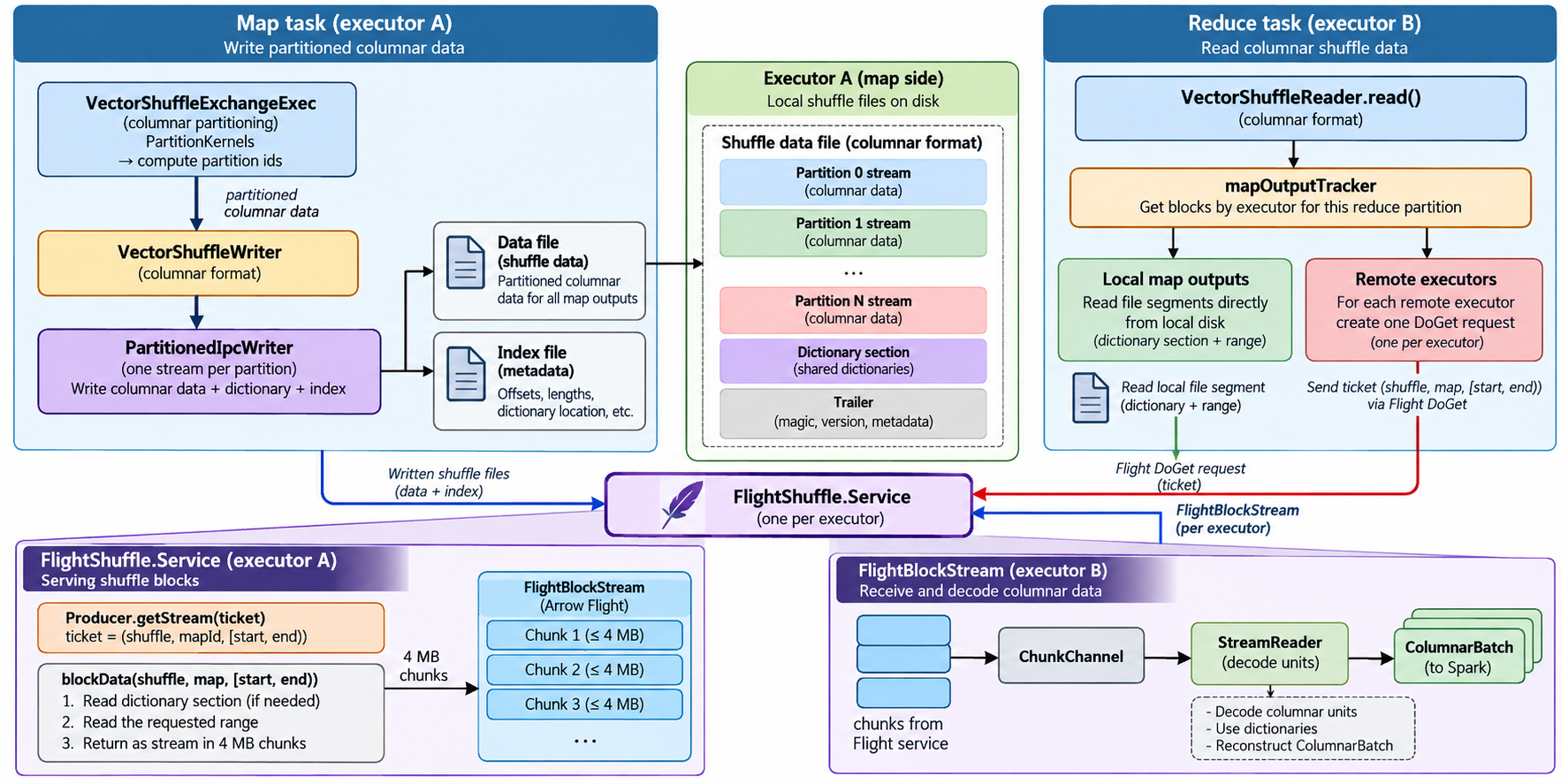
The location of every executor's server travels through Spark's plugin: the executor plugin starts
the server on the block manager's host and an ephemeral port and registers executorId -> host:port
with the driver plugin; a reducer looks a location up once per executor and caches it
(FlightRegistry). Map outputs live in the block resolver's ordinary data/index files, so
MapStatus, the map output tracker, speculation and unregisterShuffle (by tracked map task id,
#358) are Spark's own.
3. The map file
PartitionedIpcWriter produces one data file per map task. Its layout, in order:
[partition 0 stream][partition 1 stream] … [partition n-1 stream]
[dictionary section]
[trailer: offset:long, length:long, magic "SVDICT11":long]      (24 bytes, always)
[index footer: n, offsets[n], lengths[n], rows[n], bodyLen:int, magic:long]   (tests/tools only)
Under Spark the partition offsets and lengths go to the resolver's index file
(writeMetadataFileAndCommit) and the footer is not written; the trailer sits at the file's end, so
anyone holding the data file finds the dictionary section without the index. PartitionReader (tests)
reads the footer, then the trailer just before it.
3.1 A partition's stream
A partition's stream is a sequence of units, each a 12-byte header of ours followed by one Arrow IPC message:
[magic "SVB1":int][kind:int][value:int] <IPC message>
   kind 1 (dictionary):   value = column ordinal; the message is a DictionaryBatch, current for that
                          column until the next dictionary unit for it
   kind 2 (record batch): value = bitmap length; then ceil(columns/8) bytes, bit c set = column c is
                          int32 ids over its current dictionary, clear = plain UTF8; then a RecordBatch
There is no Schema message (#411: the reader knows the shuffle's schema from the dependency, and a schema message per block was measurable at 1000 partitions) and no end-of-stream marker (#347: the streams of several map outputs are read back to back as one, so a boundary needs no marker). The unit header is what lets a record batch say its own shape and lets a dictionary outlive the record batch that follows it -- Arrow's own IPC stream would tie both to the schema message.
3.2 Strings: one dictionary per column per map file (#416)
A string column travels as int32 ids over a dictionary whenever the dictionary pays. Before #416 every record batch carried its own dictionary, remapped dense from the task's staging dictionary (#345: a 200-row block should not carry a 3000-entry dictionary). At 1000 partitions a block is a few hundred rows and the remap, the dictionary batch and the reader's per-block decode were most of a string column's cost. Now:
- every string column starts in ids mode over one task-wide
StringDictionary, whatever the input's encoding -- a dictionary-encoded input batch (an aggregate's output, #377) maps by its entries, a plain one is hashed row by row into the same dictionary; - the record batches carry the staging ids directly; the dictionary is written once, whole, in the dictionary section (a dictionary unit per string column with values, one compressed frame);
- a column whose dictionary stops paying is frozen: past
DictionaryCapBytes(32 MB of distinct values) or, onceFreezeSampleRows(4096) non-null rows are seen, more distinct values thandictionaryMaxRatio(default 0.5) of its rows. Freezing flushes every partition's pending rows as ids (they stay valid: the dictionary is written whole atfinish), then the column travels plain UTF8 for the rest of the task. Rare -- the high-cardinality column of a fact table -- and cheaper than what the plain path does anyway.
Since a block's bytes alone no longer decode, every transport prepends the map file's dictionary
section to each range it serves: the Flight producer once per map output in a DoGet, the local
reader through PartitionedIpcFile.blockChannel. Spark's block-transfer backend delivers a block's
bytes alone, so under spark.vecruntime.shuffle.backend=block the writer keeps per-block dictionaries
(fileDictionary = false), the pre-#416 format.
3.3 Staging and flushing
Below StagingPartitions (256) partitions each partition has its own builders and a batch's rows are
gathered straight into them. Above it the task's rows are staged once with their partition ids and
grouped at the flush into one reusable set of batch builders (#416: at 1000 partitions the
per-partition path allocated 18,000 vectors for 1.2 MB of output). Either way a partition's pending
rows become a record batch when they reach batchRows (8192) or batchBytes (1 MB), or when the
task's held bytes reach bufferBytes (64 MB).
A partition's IPC bytes are staged raw on the heap and compressed in frames of at most flushBytes
(1 MB) through the writer's single zstd context (#411: a native context per partition was 5% of an
executor). Frames go to a per-partition overflow file as they fill; at finish the overflow files and
each partition's last frame are concatenated into the data file. Frames of one partition, and of the
consecutive partitions of a range, decompress as one stream.
Arrow's per-buffer body compression is off (NoCompressionCodec): the frame compression is where
the bytes shrink, and it sees whole messages. zstd through zstd-jni is the default; Arrow's lz4 is
pure Java and an order of magnitude slower; none for tests and benchmarks.
4. The reduce side
VectorShuffleReader.read() asks the map output tracker for the task's blocks by executor and builds
one iterator of ColumnarBatches:
- Remote executors: one
FlightBlockStreamper executor, all opened up front (#347) so every server produces at once and gRPC's flow control bounds what each stream buffers. The ticket names the shuffle, the task's reduce range[start, end)and the executor's map ids ([shuffleId:int][start:int][end:int][count:int][mapIds:long…], big-endian); the server answers with the blocks back to back. - Local map outputs: one file segment per map for the task's whole partition range (#411:
ShuffleBlockBatchId-- one index lookup and one open per map where it was one per partition times the coalescing factor), read with positional reads straight into Arrow memory.
Both feed PartitionedIpcFile.StreamReader, the one decoder:
- it reads units; a dictionary unit loads a
VarCharVectorthat stays current for its column until replaced; a record batch unit reads the shape bitmap, picks theVectorSchemaRootand loader for that shape (cached per shape) and loads the batch; - dictionaries are shared by reference count between the reader and the batches handed out over them: a replacement (the next map output's dictionary) does not disturb a batch the operator still holds, and a large per-map dictionary is never copied per batch;
- coalescing (#411): a batch under
CoalesceRows(1024) is appended to a pending plain batch instead of reaching the operators on its own -- kernel set-up, a hash table's probe round and an output batch per input batch were most of a reduce task's time over ten-row blocks. A dictionary- encoded column of such a block is decoded into the pending plain column (#438). Because aDoGetconcatenates a range's map outputs into one stream, coalescing crosses map outputs on the Flight path; the local path reads each map's segment separately. - the consumer does not close its input: a batch is closed when the next is produced, or at
close.
5. The Flight service
One FlightServer per executor over gRPC on Spark's Netty (flight-core lives in shuffle/ so the
plugin jar never carries gRPC). Producer.getStream parses the ticket and, per map id, asks the
block resolver for the range's ManagedBuffer (a file segment), prepends the dictionary section and
copies the bytes into a one-column VarBinary root, one row per chunk of ChunkBytes (4 MB). Not as
Flight record batches (#338: Flight's own framing sends dictionaries once per stream, ours replace
them within one) and not one message per map output (#416: 2,000 map outputs as 2,000 gRPC messages
of a few KB each cost a Flight decode and a flow-control round trip apiece -- a third of a reduce
task's time at 1 TB / 1000 partitions); the chunk fills across map outputs and is sent when full or
when the range ends. The server's executor pool is spark.vecruntime.shuffle.flight.threads
(default max(4, cores)).
Client side, FlightBlockStream wraps the stream in a ReadableByteChannel (ChunkChannel) the
StreamReader pulls from as it needs bytes, so decode overlaps transfer. The decoder is created on
the first hasNext, not in the constructor (#416): opening seven servers' streams back to back and
waiting for each first message inside the constructor serialised the waits. Clients are pooled per
JVM per remote location.
Security. With spark.authenticate on, every call carries Spark's shuffle secret as a bearer
token and an unauthenticated DoGet is refused; the server refuses to start when auth is on but no
secret can be read. TLS is the open gap of #288: the server needs PEM material and Spark configures
JKS, so under spark.ssl.rpc.enabled the server refuses to start rather than run in the clear --
use spark.vecruntime.shuffle.backend=block there. Without spark.authenticate the endpoint is as open
as Spark's own block transfer in that configuration.
Failures. A remote fetch that fails for any reason other than the reducer's own Arrow memory
(OutOfMemoryException) is turned into Spark's FetchFailedException carrying the block's map index
(#364), so the scheduler recomputes the lost map outputs instead of failing the job; memory failures
propagate as the reducer's error, wrapped into a serialisable exception (Arrow's is not, and on JDK
24+ an unserialisable task failure ended the executor -- SPARK-55679).
6. The backend seam
VectorShuffleBackend is the interface between the reader and the transport: remoteBlocks(address, blocks, …) returns batch iterators for one executor's blocks. Three implementations:
spark.vecruntime.shuffle.backend |
what it is |
|---|---|
flight (default) |
the Flight data plane above |
block |
Spark's block transfer against the same files, all of an executor's blocks in one request; per-block dictionaries |
| a class name | a backend with a no-argument constructor -- where a push-based shuffle service (Celeborn-style) would plug in; future work |
7. Tuning knobs and what they move
| knob | default | moves |
|---|---|---|
spark.vecruntime.shuffle.batchRows / batchBytes |
8192 / 1 MB | record batch size on the map side: larger batches, fewer messages, more map-side memory |
spark.vecruntime.shuffle.bufferBytes |
64 MB | task-wide cap on held rows before a forced flush |
spark.vecruntime.shuffle.flushBytes |
1 MB | compression frame size (one zstd call per frame) |
spark.vecruntime.shuffle.compression |
zstd |
zstd, lz4, none |
spark.vecruntime.shuffle.writer.dictionaryMaxRatio |
0.5 | distinct/rows above which a string column is frozen plain (0 never encodes, 1 always) |
spark.vecruntime.shuffle.writer.memoryLimit |
1 GB | the writer allocator's hard limit (backstop; flushes happen long before) |
spark.vecruntime.shuffle.flight.threads |
max(4, cores) |
server executor pool: concurrent DoGets an executor serves |
spark.vecruntime.shuffle.flight.bindHost |
block manager host | server bind address |
Producer(chunkBytes) |
4 MB | bytes per gRPC message (constructor parameter; benchmark sweep) |
-Dvecruntime.shuffle.reader.coalesceRows |
1024 | rows a reader accumulates before handing a batch to the operators |
8. Measuring it
Two rulers, for two different questions.
In-process, JMH -- FlightShuffleBenchmark: two Flight servers on loopback stand in for two
executors, each serving map files the real writer produced; one operation is one reduce task. Four
operations apportion the cost: reduceTask (the real path), reduceTasksConcurrent (eight reducers
against the same two servers -- where the server pool, chunk size and flow control contend),
rawTransport (the bytes undecoded: the transport alone), localRead (the same blocks with no
Flight: the floor). Aux counters give rows, batches and bytes per iteration; rows / batches is the
mean batch the operators receive. Parameters: partitions (block size), range width (AQE coalescing),
compression, server threads, chunk bytes, string columns. It measures the CPU side -- serialisation,
chunking, decode, threads -- not bandwidth; that is what the knobs above change. Run it with
benchmarks/scripts/run-flight-bench.sh (Spark is a provided dependency, so the jar alone will not
do); each run writes a JSON file, an A/B is two runs and a diff. Host noise on a shared box is
several percent: compare against a measured band.
On the cluster -- the TPC-DS matrix (benchmarks/k8s/run-matrix.sh) with event logs, read per
stage: shuffle write time and bytes of the map stage, fetch wait and executor time of the reduce
stage. That is the ruler that found #347 (round trips), #411 (per-partition costs), #416 (per-block
costs) and #377 (the dictionary's other side): each began as a stage whose executor time did not
match its bytes.
9. Open items
- TLS for the Flight server (#288): PEM from Spark's JKS, or Spark's own SSL context.
- A push-based shuffle service through the backend seam (Celeborn or our own aggregator); the
StreamReaderalready decodes several map outputs' streams concatenated, which is what an aggregated partition would hold. - A frozen column's dictionary is still written whole; a column frozen very early could drop it.
- The block-transfer backend keeps the per-block format; if it stays, its writer path could carry the dictionary section as a prefix instead.